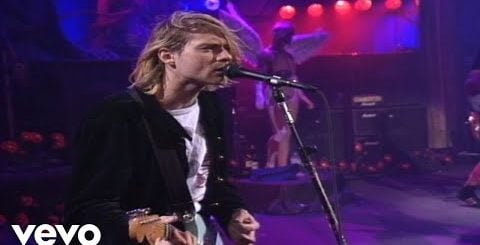
On a Plain by Nirvana Lyrics Meaning – Unraveling Kurt Cobain’s Lyrical Labyrinth
- Music Video
- Lyrics
-
Song Meaning
- A Self-Scrutinizing Vortex: ‘I got so high, I scratched ’till I bled’
- The Dichotomy of Love and Self-Esteem: ‘Love myself better than you’
- Dissecting the Peculiar Euphoria: ‘The finest day, that I’ve ever had’
- Echoes of Existential Crises: The Song’s Hidden Meaning
- Lines That Linger: ‘Somewhere I have heard this before’
Lyrics
I got so high, I scratched ’till I bled
Love myself, better than you
I know it’s wrong, so what should I do
The finest day, that I’ve ever had
Was when I learned, to cry on command
Love myself, better than you
I know it’s wrong, so what should I do
I’m on a plain, I can’t complain
I’m on a plain
My mother died, every night
It’s safe to say, don’t quote me on that
Love myself, better than you
I know it’s wrong, so what should I do
The black sheep got, blackmailed again
Forgot to put, on the zip code
Love myself, better than you
I know it’s wrong, so what should I do
I’m on a plain, I can’t complain
I’m on a plain
Somewhere I have heard this before
In a dream my memory has stored
As a defense I’m neutered and spayed
What the hell am I trying to say
It is now time, to make it unclear
To write off lines, that don’t make sense
Love myself, better than you
I know it’s wrong, so what should I do
And one more special, message to go
And then I’m done, then I can go home
Love myself, better than you
I know it’s wrong, so what should I do
I’m on a plain, I can’t complain
I’m on a plain, I can’t complain
I’m on a plain, I can’t complain
I’m on a plain, I can’t complain
I’m on a plain
Decoding Nirvana’s gritty sonic snapshots often feels like peeling back the layers of a deeply troubled soul. ‘On A Plain’—a standout track from the band’s seminal 1991 opus, ‘Nevermind’—captures Kurt Cobain’s raw essence in a blistering three-and-a-half minute window. It’s a song that’s as deceptively simple in its composition as it is complex and paradoxical in meaning.
With a title that suggests both a cry for normalcy and a punnish nod to cocaine, ‘On A Plain’ tows a line between the literal and figurative, encapsulating a rhythm of self-aware and self-destructive musings. Here, we dive into the depths of Cobain’s psyche and the song’s multifaceted poetry, dissecting a tune that continues to resonate with audiences over three decades later.
A Self-Scrutinizing Vortex: ‘I got so high, I scratched ’till I bled’
The song’s opening line plummets us into Cobain’s personal struggles with addiction and fame. The act of scratching until bleeding is a poignant metaphor for self-destruction in the pursuit of euphoria—an unfiltered glimpse into his cycle of dependency and pain. With his guttural growl, Cobain forces us to confront the uncomfortable truth about the cost of excessive indulgence, pulling no punches in the delivery.
Nirvana’s ‘On A Plain’ ambushes the listener with its stark realism. Cobain’s ability to interlace his battle with internal demons and the external pressure of stardom results in a raw and unsanitized portrayal of his reality, challenging the romanticized image of the tortured artist.
The Dichotomy of Love and Self-Esteem: ‘Love myself better than you’
Repeated ad nauseam throughout ‘On A Plain’, the assertion of self-love juxtaposed with the acknowledgment of wrong-doing strikes a nerve. It’s an anthem of the conflicted: a message that self-preservation doesn’t always equate to purity of action. In his gravelly timbre, Cobain confesses to this internal war, a poignant reminder that the hardest person to forgive is often oneself.
More than a mere lyric, this self-affirmation-turned-mantra captures the very essence of the grunge ethos—an unapologetic embrace of imperfection and defiance of the mainstream moral compass. Cobain presents a stark illustration of wrestling with one’s flaws while still holding on to a thread of self-respect.
Dissecting the Peculiar Euphoria: ‘The finest day, that I’ve ever had’
Irony and morbidity dance hand in hand as Cobain recalls the ‘finest day.’ In this ironic revelation, we see the allure of sadness taking center stage. Cobain’s prowess in evoking emotion from the bleakest circumstances reveals a nuanced understanding of joy—how sometimes the most profound moments spring from a well of sorrow.
This particular slice of ‘On A Plain’ symbolizes the quintessential grunge aesthetic—a celebration of despondency and a grappling with life’s absurdity. Through Cobain’s eyes, crying ‘on command’ becomes a moment of strange liberation, a performative purging that transcends the throes of despair.
Echoes of Existential Crises: The Song’s Hidden Meaning
‘On A Plain’ resonates as a testament to the existential dread that permeated Cobain’s artistry. As he weaves through allusions to personal heartaches and trivial grievances, there’s an undercurrent of futility. The sense that ‘every night,’ some ephemeral mother of invention ‘dies,’ points to the negation of norms and a dissolution of meaning.
Cobain’s ability to express the intangible through lyrics that vacillate between the enigmatic and the painfully direct illustrates a struggle to wrestle meaning from the chaos of existence. It’s this delicate balancing act between opacity and transparency, sense and nonsensicality, that invites endless interpretation and solidifies ‘On A Plain’ as an enduring piece of the grunge pantheon.
Lines That Linger: ‘Somewhere I have heard this before’
The reflective quality of this particular line serves as a meta-commentary on the cyclical nature of life and music—a hazy recollection that blurs the line between past experience and déjà vu. Cobain channels the collective unconscious of rock ‘n’ roll, drawing from a pool of shared memory.
In doing so, ‘On A Plain’ becomes more than an isolated track; it is an archetype reshaped, a melody caught in the echo chamber of time—familiar yet jarringly novel in its raw, unrefined edge. These words echo long after the song ends, reverberating with the timeless sentiment that in every new chord progression, we find shadows of the bygone.