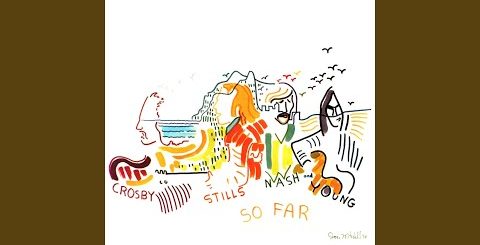
Our House by Crosby, Stills, Nash & Young Lyrics Meaning – A Harmony of Homely Bliss within a Melodic Framework
Lyrics
You place the flowers in the vase
That you bought today
Staring at the fire
For hours and hours
While I listen to you
Play your love songs
All night long for me
Only for me
Come to me now
And rest your head for just five minutes
Everything is done
Such a cosy room
The windows are illuminated
By the evening sunshine through them
Fiery gems for you
Only for you
Our house is a very, very, very fine house
With two cats in the yard
Life used to be so hard
Now everything is easy
‘Cause of you
And our la,la,la, la,la, etc.
Our house is a very, very, very fine house
With two cats in the yard
Life used to be so hard
Now everything is easy
‘Cause of you
And our
I’ll light the fire
While you place the flowers in the vase
That you bought today
In the fabric of folk-rock tapestry, ‘Our House’ by Crosby, Stills, Nash & Young stands as an emblematic weave of domestic bliss and romantic simplicity. Released in 1970 on their seminal album ‘Déjà Vu’, the song captures a snapshot of idyllic love, serving as a contrast to the turbulence of its era.
Pinned against the backdrop of the Vietnam War and societal upheaval, ‘Our House’ emerges as a sanctuary of peace and comfort. The lyrics, though seemingly straightforward, open doors to rooms filled with symbols, endeavoring to explore the hidden significance embedded in the song’s melodic heart.
The Fireplace Flickering With Memories
The opening lines, ‘I’ll light the fire / You place the flowers in the vase’, set the domestic scene so vividly that the warmth can almost be felt radiating through the speakers. It speaks to a shared routine, the little acts of care and love that anchor a relationship. The fact that these chores are mundane does not diminish them; instead, they are elevated to a ritual that sustains the hearth of companionship.
Amidst the simplicity, there’s also a nod to time and tradition. Fire has been the centrepiece of the home since time immemorial, symbolizing not only warmth but also societal and familial continuity. In ‘Our House’, this symbolism is repurposed to articulate the burning heart of a romance alive and enduring.
An Ode to the Mundane Turned Magical
The song’s celebration of the ordinary leaves an extraordinary impact. There is nothing spectacular about placing flowers or staring into the fire, yet the act of ‘staring at the fire / For hours and hours’ becomes a kind of meditation, a testament to finding contentment in presence rather than seeking always-new excitement. It encourages the listener to find beauty in the quotidian routines that knit the fabric of everyday life.
Each task is a quiet declaration of love. Even the most inconspicuous activities are suffused with meaning when shared with that special someone. In an era where love songs often mined grand gestures and high drama, ‘Our House’ makes a soulful case for the understated yet profound connection found in simple companionship.
A Lyrical Shelter from the Societal Storm
Against the cacophony of the 1960s and ’70s counterculture, ‘Our House’ presents a juxtaposition. It offers a personal haven, reflective of a desire to retreat into comfort and predictability. The repeated line ‘Our house is a very, very, very fine house’ transcends mere affirmation and becomes a mantra of security and pride.
The safe containment of ‘our house’ is compounded by the intimacy of ‘a cosy room’ whose ‘windows are illuminated by the evening sunshine.’ The song, in its essence, offers solace in the certainty of one’s intimate space, undisturbed by external chaos.
The Ascension of the Everyday into Iconography
Nestled within the song’s serene rhythms are emblematic symbols, such as ‘two cats in the yard,’ that evoke an iconic image of domestic serenity. These are not merely pets; they are characters in the narrative of homestead harmony. Their casual mention captures an illustrative moment that has since been etched into the collective memory of the counter-culture.
The repetitive nature of both lyrics and melody in the ‘la,la,la, la,la’ sequence mirrors the pleasant, cyclical nature of domestic life. Each reiteration of this refrain invites the listener to linger in the comfortable familiarity of the song’s acoustic embrace, not unlike the repeated joys found in the daily rhythm of home life.
The Intangible Whispers: Delving into Song’s Secret Chamber
Peering beyond the veneer of simplicity reveals ‘Our House’ as a subtle rebellion—a declaration of personal joy in an era overshadowed by disillusionment. It hints at the radical notion that true happiness could reside not in grand societal overhaul but in the unassuming love shared between two souls.
The line ‘Life used to be so hard / Now everything is easy ’cause of you’ speaks volumes about the transformative power of love. In a climate where struggle was the daily fare for many, to find solace in domestic love was to embrace a revolutionary kind of personal peace—one that insisted that amidst the turmoil of the outside world, ‘our house’ could be a stronghold of comfort and an epicentre of a different kind of revolution—one of the heart.