Pagan Angel and a Borrowed Car by Iron & Wine Lyrics Meaning – Unveiling the Mystique of Folk Melancholy
Lyrics
In a frozen copse of trees
A bone cold and older than our bodies
Slowly floating in the sea
Every morning there were planes
The shiny blades of pagan angels in our father’s sky
Every evening I would watch her hold the pillow
Tight against her hollows, her unholy child
I was still a beggar shaking out my stolen coat
Among the angry cemetery leaves
When they caught the king beneath the borrowed car
Righteous, drunk and fumbling for the royal keys
Love was a father’s flag and sung like a shank
In a cake on our leather boots
A beautiful feather floating down
To where the birds had shit on empty chapel pews
Every morning we found one more machine
To mock our ever waning patience at the well
Every evening she’d descend the mountain stealing socks
And singing something good where all the horses fell
Like a snake within the wilted garden wall
I’d hint to her every possibility
While with his gun the pagan angel rose to say
My love is one made to break every bended knee
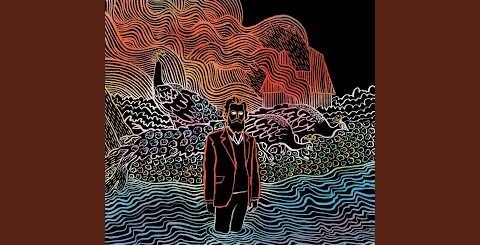
Iron & Wine, the musical project led by singer-songwriter Sam Beam, has consistently gifted the indie folk scene with lyrical complexity and haunting melodies. ‘Pagan Angel and a Borrowed Car’ from the album ‘The Shepherd’s Dog’ (2007) is no exception. With evocative imagery that brushes the canvas of folk lore and modernity, Beam encapsulates themes of love, loss, and existential musings.
Beneath the acoustic strums and Beam’s hushed vocals lies a tapestry woven with threads of poetic allegory. The song can be perceived as a journey through a landscape both familiar and surreal; a journey that invites listeners to dissect its passages for deeper meanings—a journey that eschews vapor-like promise for something more tangible, more piercing.
The Haunting Promise of Love and Desolation
In the opening verse, Beam spins a narrative of love as ephemeral as smoke, shrouding listeners in a scene of wintry desolation. The ‘frozen copse of trees’ and the ‘bone cold’ evocative of love’s often hard and unforgiving nature. It is here that love does not provide warmth, but rather, becomes synonymous with the cold inertia of life’s inevitable challenges.
From the outset, the song positions love not as a flourishing fire but as a chilled, slow-moving entity—perhaps a meditation on its potential to be as isolating as it is intimate. This duality creates a haunting dichotomy, reminding one of love’s ability to entrap and liberate simultaneously.
Pagan Angels and the Dichotomy of Sacred and Profane
‘Pagan Angel and a Borrowed Car’ contemplates contrasts—the sacred and the profane, the eternal and the ephemeral. With ‘angry cemetery leaves’ and ‘shiny blades of pagan angels,’ Beam taps into an archetypal well, painting a scenario where traditional paradigms of belief are met with subversive realities.
These ‘pagan angels’ could be emblematic of unconventional guides or forces, suggesting perhaps a divine intervention that edges on the heretical. The song challenges the sanctity of the proverbial father’s sky with the idea that even heavenly creatures bear tainted wings—not a fall from grace, but rather an embrace of worldly imperfections.
Stealing Socks and Singing Sirens: The Revolt Against Daily Monotony
There is an understated rebellion humming through the verses. ‘Every evening she’d descend the mountain stealing socks’ speaks to a sort of poetic banditry, a day-to-day uprising against the pedestrian and the predictable. Yet even this act is painted as an artistic endeavor, ‘singing something good where all the horses fell,’ implicating the presence of beauty in the process of defiance.
Beam’s lyrical artistry lies in his harnessing of everyday imagery to portray deeper unrest—a common theme in his work—a sense that the mundane is just a veneer for the rich and complex emotional landscapes beneath.
A Royal Fall: Dissecting the Song’s Hidden Meaning
Iron & Wine songs are replete with allegory and ‘Pagan Angel and a Borrowed Car’ skillfully disguises its most poignant criticisms within otherworldly metaphors. When the ‘king’ falls ‘beneath the borrowed car,’ it symbolizes the deconstruction of authority, the sobering reality that even the divine falter beneath the weight of their vices.
The borrowed car—a transient, impermanent symbol—juxtaposed with the timeless sovereignty of a king, reinforces the song’s meditation on temporality versus permanence. It delivers a striking commentary on the eventual demise of structures and symbols we hold in esteem.
Immortal Lines: Echoes of a Poet’s Heart
‘My love is one made to break every bended knee,’ Beam declares in the song’s closing. This line harkens to a profound statement on the conflict between personal affection and external pressures; a love so fierce, it could shatter the constraints of conformity and expectation placed upon individuals who simply yearn to bend to their own internal compass.
It encapsulates the song’s voracious appetite for delving deep into the human experience, challenging listeners to reflect on the nature of their own affections and the forces that may seek to bind or liberate them.