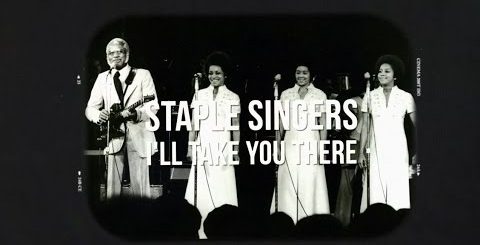
“Why? (Am I Treated So Bad)” by The Staple Singers
“Why? (Am I Treated So Bad)” is said to be based on the experiences of the Little Rock Nine. The Little Rock Nine were, most simply explained, a group of teenage students who, in 1957, were used to break the color barrier in American education.
Said year of course harps back to a time in US history when many Whites, including the Governor of Arkansas (and by extension its capital, Little Rock) were publicly against racial integration. So needless to say, the Little Rock Nine went to experience an ample amount of persecution while attending Little Rock Central High School.
So by the looks of things, only four of them actually went on to graduate from the institution. But the fact that they were able to attend and for the most part successfully endure (with, by the way, armed assistance from the US federal government) is considered to be a landmark moment in the Civil Rights struggle and has thus lent to the Little Rock Nine being perceived as champions of justice.
Lyrics of “Why? (Am I Treated So Bad)”
Be that as it may, a listener would be hard-pressed to determine such as the backstory of this song based solely on its lyrics. Well, the first verse does an effective job of depicting the vocalist as someone who is being unfairly dealt with in a wrongful manner.
But it would appear that even back in those days (if it is in fact true that this song was inspired by the Little Rock Nine) that songwriters could not resist the temptation of putting a universal message, such as unjust abuse in this case, into a romantic context.
So once said verse does conclude, the lyrics transform into the vocalist more specifically lamenting a situation that reads as if she was unceremoniously dumped by her boyfriend. Or in any event, he greatly offended her by claiming that she’s “too vain”. And in general, he is presented as ‘treating her so bad’ which, all lyrics considered, sounds like her “baby” is verbally abusive.
But that noted, similar to the Littler Rock Nine it can be said, she has decided to endure such mistreatment and “love him just the same”.
The Conclusion
Conclusively, yes, this track does end up faithfully sticking to the topic of the vocalist being an innocent, may we even say self-sacrificing, victim of abuse. And such a mentality was, in all honesty, part and parcel of the African-American struggle for equal rights under the likes of Martin Luther King Jr., who reportedly dug this tune.
But this is far from what is generally considered to be a civil rights’ song. For instead of coming off as a casualty of institutionalized injustice, by the time all is said the done the narrator rather sounds more like someone who has fallen in love with a toxic partner.

The Staple Singers
The Staple Singers were a multi-genre family act that was around during the better part of the late 20th century. At the head of the clan was the late Pops Stables (1914-2000). He was joined by his offspring:
- Cleotha (1934-2013)
- Mavis and Pervis (1935-2021)
- Yvonne (1937-2018)
They were a staple (no pun intended) of the African-American music scene for quite a few decades but especially during the 1970s. Prior to that they also released a classic or two, such as “Why Am I Treated So Bad?”, which came out in 1966.
“Why? (Am I Treated So Bad)”
This song was written by Pop Staples, with its producer being Billy Sherrill (1936-2015).
This track, which is one of the earliest in The Staples Singers’ discography, did appear on the Billboard Hot 100, though barely thereupon.
This song is sort of the title track of The Staple Singers’ album it is derived from, which itself is titled “Why”.

The Little Rock Nine
The government of The US declared in 1954, all acts of segregation unlawful and unconstitutional. It was at this same time that nine black students decided to defy the status-quo on September 4, 1957. They registered into the Little Rock Central High School, an all-white public school in Arkansas where they faced massive opposition.
The nine students (Little Rock Nine) were enrolled in the school by black female advocate Daisy Bates. The nine were:
- Elizabeth Eckford
- Carlotta Walls LaNier
- Ernest Green
- Minnijean Brown
- Gloria Ray Karlmark
- Terrence Roberts
- Thelma Mothershed
- Melba Patillo Beals
- Jefferson Thomas
On the day the students reported to the school, they were screamed at, spat on, and faced hostile protesters. The Governor of the state at the time, Orval Faubus also ordered national guards to surround the school and prevent the students from entering.
The image of black students being restricted by National guards did not sit well on International news, forcing the hand of the then-president David Eisenhower to send the National Army to retire the group of National guards deployed by Orval Faubus.
Three weeks after this unfortunate situation, on September 25th, 1957, the nine black students were finally allowed into class, escorted by soldiers. In November 1999, former president Bill Clinton honored them with a Congressional Gold Medal each.