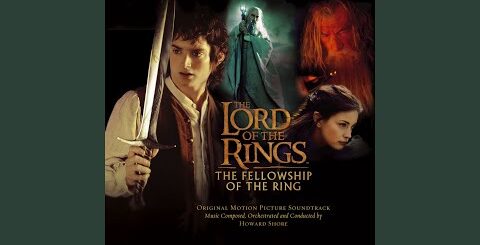
The Prophecy by Howard Shore Lyrics Meaning – Unveiling Middle-Earth’s Musical Enigmas
- Music Video
- Lyrics
-
Song Meaning
- An Overture to Destiny: Understanding The Song’s Narrative Arc
- Lyrical Linguistics: Delving into Tolkien’s Elvish Lexicon
- Chronicle of Immortality: The Perpetual Struggle Against Fate
- Deciphering The Hidden Meaning: The Seer’s Vision and Its Implications
- Memorable Lines in a Sea of Symphonies: The Power of Minimalist Lyrics
Lyrics
tulinte I quettar
tercano nuruva
Hlasta Qyetes
Hfirimain
The Ringspell…
Translation:
The Seer Speaks…
Out of the Black Years
come the worlds
the Herald of Death
Listen — it speaks to
those who were not born to die
The Ringspell…
In the sonic tapestry of Middle-Earth, few threads are as evocatively woven as the strains of ‘The Prophecy’ from Howard Shore’s score for ‘The Lord of the Rings’. This piece, a haunting merger of orchestral majesty and linguistic depth, compels a profound introspection into the universe that J.R.R. Tolkien birthed—a mythology imbued with fate, destiny, and the inexorable flow of time.
‘The Prophecy’ is not merely a musical composition but a narrative conduit. Through a pairing of Tolkien’s constructed Elvish languages and Shore’s orchestral vision, the song delivers us to the heart of the narrative’s gravitas—a prelude to an epic saga. The lyrics, sparse as they might be, echo with the weight of forecast and forewarning, an invitation to shovel through sonic layers for the hidden gems of meaning.
An Overture to Destiny: Understanding The Song’s Narrative Arc
The melody acts as a premovement, setting the stage for the epic odyssey of Middle-Earth. In the throes of ‘The Prophecy’, one feels the impending doom as much as the glimmers of hope that lie beyond the horizon. To grasp the song’s narrative arc is to perceive the undercurrents of an entire realm poised on the precipice of time—where the echoes of the past meet the whispers of the future.
By invoking ‘The Black Years’ and the ‘Herald of Death’, Shore encapsulates the encroaching darkness of Sauron’s ascendancy. The music delivers these words not as a simple lore but as a chronological testimony; a prehistoric peril reawakened, an omen of the trials to ensue. It is an overture to the unwritten ‘destiny’ of the characters who will rise and fall to the symphony’s crescendo.
Lyrical Linguistics: Delving into Tolkien’s Elvish Lexicon
The lyrics of ‘The Prophecy’, though succinct, draw from the deep wells of Tolkien’s linguistic creation. The words in Elvish, a language of enigmatic elegance, serve as a cryptic canvas for Shore to paint his auditory picture. The stark call to ‘Listen’ is a linguistic lure into a world where the fate of inhabitants is as much a consequence of their actions as the prophecies that bind them.
Elvish phrases like ‘Yénillor morne’ and ‘tulinte I quettar’ are not just mystifying in melody but in meaning. They compel the listener to seek out the lore, to decode the Elvish tongue, and therein uncover the breadth of narrative and emotion that Shore threads through his symphonic storytelling.
Chronicle of Immortality: The Perpetual Struggle Against Fate
In the core of the lyrics lies the idea of immortality, not as a blessing, but as a potent, dual-edged sword. ‘Those who were not born to die’—this haunting phrase encapsulates the Elven race’s tragic blessing. In a world rife with loss and decay, their unending existence is a poignant testament to the ethereal and solemn nature of Shore’s composition.
It speaks to the timelessness of Middle-Earth’s struggle, to the recurring cycles of war and peace—a prophecy that foretells not just events but encapsulates the very being of its immortal children. The song manages to articulate an existential dichotomy, the beauty and burden of eternity, swathed in a haunting melody that resonates with temporal profundity.
Deciphering The Hidden Meaning: The Seer’s Vision and Its Implications
The personification of ‘The Seer’ in ‘The Prophecy’ signifies a bridge between the tangible and the ethereal, between history and the realm of foresight. Shore’s composition touches upon this conduit of time, employing Tolkien’s themes of power and the corruptibility of even the most stalwart of souls.
This Seer, whispering through the ages, embodies the very essence of the song—a testament to the cyclical nature of history and the inevitability of certain fates. Howard Shore crafts each note to act as an oracle’s vessel, to weave the threads of past prophecies into the present fabric, and to cast shadows over the future of the story’s lineage.
Memorable Lines in a Sea of Symphonies: The Power of Minimalist Lyrics
Even amidst the vast, swelling orchestrations of Shore’s compositions, it is the sparse, potent lines of ‘The Prophecy’ that carve the deepest grooves in the listener’s memory. ‘Hlasta Qyetes Hfirimain’—the command to ‘listen’—is more than an invitation; it’s a call to spiritual vigilance.
The subtlety of the lyrics serves not only to further the narrative but to pivot the emotional compass of the listener. With an economy of words, Shore conjures the full gamut of emotions that bespeak of doom, hope, and the indomitable spirit of the characters that inhabit Tolkien’s timeless epic—each word a microcosm of the larger, sprawling narrative tapestry.